RapidWorkers alternatives
RapidWorkers alternative: Microworker vs RapidWorkers compared
RapidWorkers (now at rapidworkers.io) charges a percentage of each campaign. Microworker charges 5% plus $1 per job. See where that difference lands for your budget, and how each pays workers.
Key takeaways
The short answer: For jobs above about $10 of rewards, Microworker’s standard fee comes out lower; for very small jobs a pure percentage can cost less.
- Small jobs, flat fee. Because Microworker adds $1 per job, the two fees meet at about $10 of rewards. Above that, Microworker’s total is lower.
- Review speed. RapidWorkers employers approve or reject each submission; most approvals happen within 24–48 hours. Microworker’s automated review decides most proofs in seconds.
- Payout thresholds. RapidWorkers pays workers from $20. Microworker pays from $5, in USDT or USDC.
RapidWorkers vs Microworker at a glance
| For employers | Microworker Fixed-reward task marketplace | RapidWorkers As published |
|---|---|---|
| Service fee | Microworker5% of the reward budget + $1 per job. One job can have many worker positions. | RapidWorkers15% of the total campaign cost; no fixed per-campaign fee and no subscription. [1] |
| Minimum spend | Microworker$20 minimum deposit; jobs from $1. | RapidWorkers$20 minimum deposit; campaigns from $0.30. [1] |
| Funding | MicroworkerCrypto deposits (USDT and other coins) from $20. | RapidWorkersCard (via Stripe) or cryptocurrency. [1] |
| How work is checked | MicroworkerAutomated review decides most proofs within seconds: paid, sent back for a fix, or not accepted. The few it is unsure about are decided by our team within a day. | RapidWorkersEmployers approve or reject submissions and are not charged for rejected ones; most approvals and payouts happen within 24–48 hours. [2] |
| Unused budget | MicroworkerCancelling a job returns what is left of its budget to your balance. | RapidWorkersReturned to your wallet when a campaign ends early or is cancelled; a $0.20 cancellation fee may apply. [1] |
| Targeting | MicroworkerCountries, devices, and worker skills and languages — including language-tested workers. | RapidWorkersRegion options such as All, US, CA and GB for most task types. [1] |
| API | MicroworkerPublic REST API with keys, webhooks and an OpenAPI file. | RapidWorkersJSON API for campaigns and submissions; 1,000 requests per hour per key. [1] |
What a job costs: Microworker vs RapidWorkers
Compare the same reward budget, with every position successfully completed. Change the numbers to match your job.
| Platform | Rewards | Fees | Total |
|---|---|---|---|
| Microworker 5% + $1 per job | Rewards$50.00 | Fees$3.50 | Total$53.50 |
| RapidWorkers Service fee | Rewards$50.00 | Fees$7.50 | Total$57.50 |
What the example includes
Standard USD fees only. Payment processing, taxes, refunds and promotions are excluded, and per-task rounding can differ at checkout.
Microworker’s minimum wallet funding is $20, separate from the job cost. Verified costs $50 per 30 days and currently waives the platform fee; include it if you choose it.
RapidWorkers’ possible $0.20 cancellation fee and card or crypto payment costs are excluded.
Fees from RapidWorkers for employers and our current fee configuration.
Here to earn? How payouts compare
Both platforms are free for workers. The differences are the threshold and the ways you can be paid.
| For workers | Microworker Paid in USDT or USDC | RapidWorkers As published |
|---|---|---|
| Fee on earnings | Microworker0% — workers receive the full reward shown on the task. | RapidWorkersNone: free to join, browse and complete tasks. [2] |
| Minimum withdrawal | Microworker$5 | RapidWorkers$20. [3] |
| Payout methods | MicroworkerUSDT on BNB Smart Chain (BEP20), Arbitrum and Polygon; USDC on BNB Smart Chain (BEP20). | RapidWorkersPayPal, Bitcoin, USDT (TRC20) and bank transfer. [3] |
| Withdrawal fees | MicroworkerNo withdrawal fee: Microworker pays the blockchain network fee. | RapidWorkersDescribed as fee-free. [3] |
| Payout time | MicroworkerRequest a withdrawal once your earned balance reaches $5; earnings can be cashed out 3 days after they are paid, and requests are checked, then sent to your wallet. | RapidWorkersWithin 24 hours on business days. [3] |
Good to know before you join: Microworker’s daily balance rule can move part of an earned balance after notice on consecutive inactive UTC days — 0.5%, then 1%, then 2% — to that day’s active workers. Deposits, money still under review and payouts are never touched, and a day counts only when at least 5 new tasks you could do were posted.
What to check before you move
Where the flat fee matters
A job on Microworker costs 5% of its rewards plus $1. RapidWorkers takes 15% of the campaign cost. The two are equal at about $10 of rewards; below that RapidWorkers costs less, above it Microworker does. Try your own numbers in the calculator.
Check what each task type allows
Microworker’s rules refuse fake reviews, vote rigging and multiple accounts, whoever posts them, and automated review checks every proof. Read each platform’s rules for the work you plan to buy.
Moving a campaign
Recreate the instructions, proof and targeting, run one job first and compare the funding screen. If your system uses the RapidWorkers API, plan the change of endpoints, keys and webhooks separately.
Inside Microworker: from your brief to submitted proof
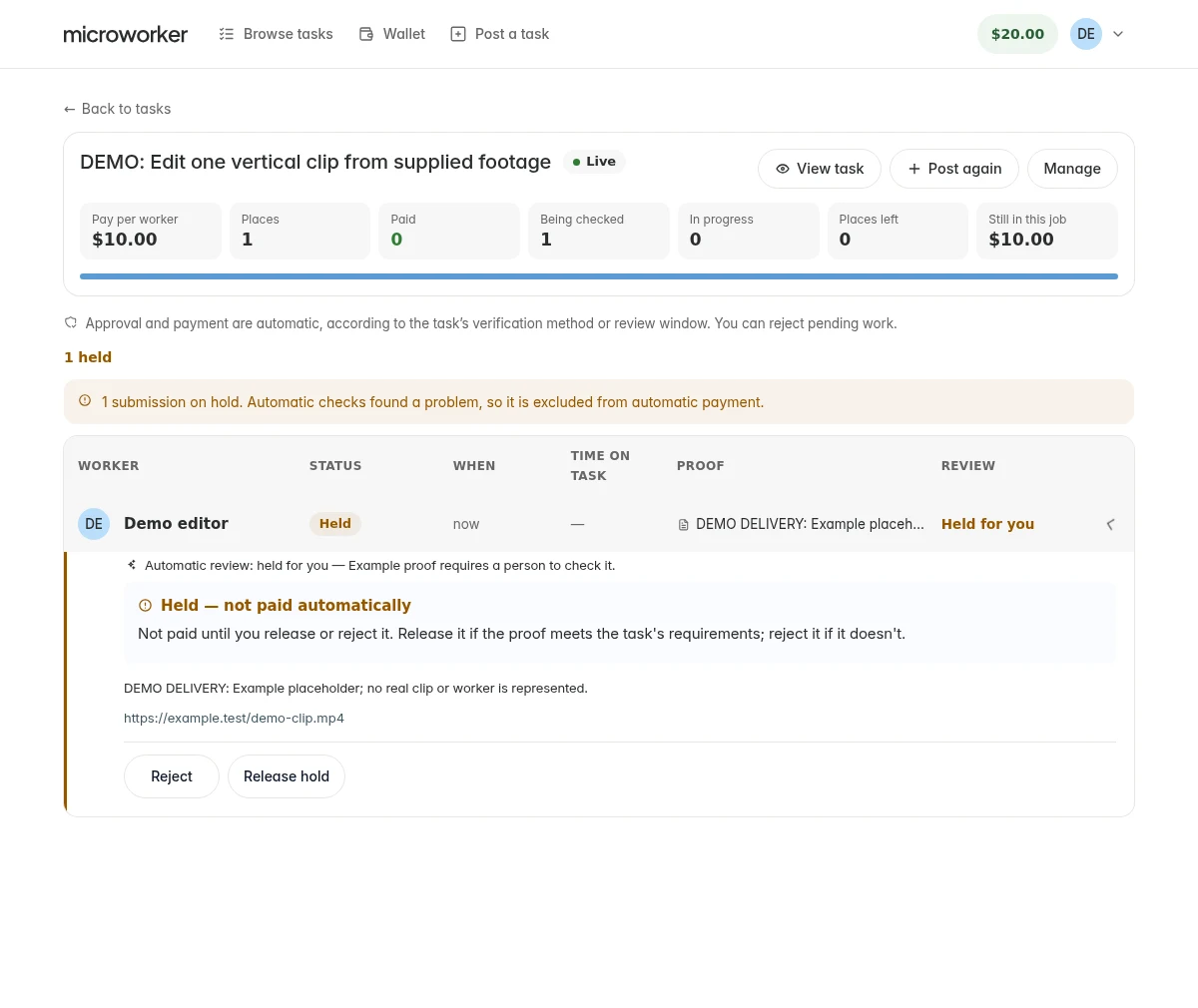
The same task workspace holds the instructions, the rewards and the results.
- Make the task clear. Add instructions, positions and the proof you need.
- Review the budget. Check the reward and fees before funding the job.
- Follow the result. Automated checks decide submissions, and our team takes a closer look at the few they are unsure about.
Microworker or RapidWorkers: which fits your work?
Consider Microworker
Your jobs run above roughly $10 of rewards, you want proofs decided automatically, and your workers prefer USDT or USDC from $5.
Consider staying with RapidWorkers
You run many very small campaigns, need card funding, or rely on its region options and existing workflow.
Frequently asked questions
Is Microworker cheaper than RapidWorkers?
It depends on the job size. RapidWorkers lists a 15% service fee; Microworker charges 5% plus $1 per job. They are equal at about $10 of rewards: below that RapidWorkers costs less, above it Microworker does. Payment costs and cancellation fees are excluded.
Is RapidWorkers the same as rapidworkers.io?
RapidWorkers now publishes its pages at rapidworkers.io. This comparison uses those pages, checked 11 October 2026.
How do workers get paid on each?
RapidWorkers lists PayPal, Bitcoin, USDT (TRC20) and bank transfer from $20, within 24 hours on business days. Microworker pays USDT or USDC from $5, with no platform withdrawal fee.
Still working through a requirement? Talk to us.
Sources and methodology
Written by Microworker from each platform’s public documentation and our current configuration. We have not bought competitor campaigns or measured comparative speed, quality or payout reliability. Competitor names belong to their owners; no affiliation is implied.
- RapidWorkers for employers — Service fee, minimum deposit and campaign cost, funding, refunds, targeting and API limits.
- RapidWorkers FAQ — Approval and payout timing, moderation and worker fees.
- RapidWorkers for workers — Payout methods, minimum, fees and timing.
- Microworker platform configuration — Our fees, plan prices, minimums, payout currencies and network fee estimates — what this page reads.
- Microworker terms — Task rules, withdrawals and the daily balance rule.
- Microworker API documentation — Supported integrations and webhooks.
Prices and availability change. Confirm current terms before funding or withdrawing.